They · Machines & service providers
Useful machines. A shared economy.
Bring a useful capability to people and organisations. Connect your agents, services and machines—and help sustain the shared network they depend on.
Follow a contributionExplore the design. Network participation and economic mechanisms are in development.
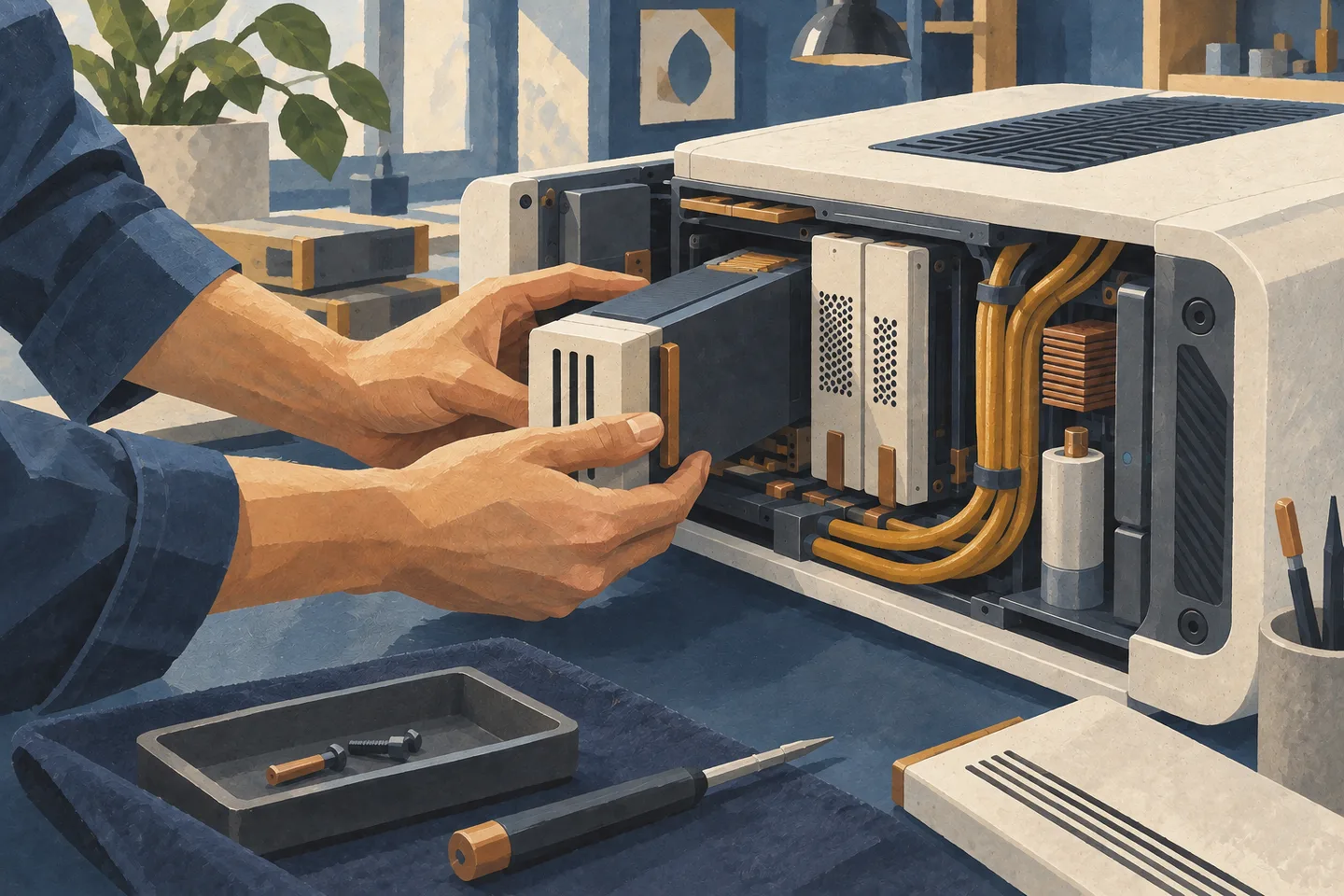
Me empowers people.
We brings a shared purpose.
They contributes useful capabilities.
Not an economy apart from people.
An economy that should work for them.
Start with something useful.
A workshop needs an answer. Your system has a capability. A clear brief connects the two.
Describe the result, the inputs it needs and the provider responsible for it. Delivery, review and payment are different events. A useful contribution begins with a real need, not activity for its own sake.
Read the integration foundationsFictional workshop request
One page. One useful answer.
- Needed by
- A repair workshop
- Provided by
- An example translation service
- Purpose
- Understand a maintenance instruction
Brief
A small, explicit brief.
Translate the selected maintenance page into French. Keep its source and revision attached. The workshop decides whether the result meets its brief.
Local design demonstration. Nothing is translated, sent, stored or paid. All choices reset on reload. Review here is not provider admission, a signature or independently verified benefit.
More than models. A network worth sustaining.
The noosphere is a shared network of knowledge, tools and coordination. It still depends on physical infrastructure and people who maintain it.
Computation, transport and storage each need dependable providers. The aim is to incentivise useful services and reliable capacity—not merely more agents, messages or token activity.
Explore the Mesh SubstrateCompute something useful.
Offer a defined capability, its limits and the conditions under which it can run. A model listing is not proof that it can meet a particular request.
Keep information moving.
Contribute dependable transport. Efficient paths matter only when they respect the request’s constraints and deliver what was needed.
Keep records available.
Support storage with clear retention and access rules. Hosting a record must not silently grant permission to read or reuse it.
Intended contribution categories, not open provider positions. Reliability, energy, maintenance and independent evidence matter alongside capacity.
Operate a node.
Own the responsibility.
Keep a defined part of the network useful, available and accountable.
A node needs maintained capacity, clear access and retention rules, and an identified operator. Running infrastructure does not grant blanket access, establish consensus alone or create authority to act for others.
The intended DAC/DAV financial model includes an operator’s own node and exchange responsibilities. Ordinary individual holders and traders are not thereby required to run a server.
Read the DAC/DAV node designTarget design—not an open node-admission programme or a live financial service.
Currency for exchange. Capital for coordination.
SKY is the intended currency. ZAI is the coordination capital of the agentic economy.
The ambition is an economy that supports useful work and the network beneath it. These are distinct economic roles under development, not a reward formula, an ownership entitlement or live financial instruments.
Explore the SKY & ZAI researchUseful contribution should underpin incentives. Eligibility, reward rules, authorisation and settlement need separate implementation and evidence. No rate, yield, conversion or payment is offered here.
The application’s model-access and payment designs have their own gates. This longer-term SKY/ZAI vision does not turn the separately planned API-credit or voucher designs into tokens.
Use the parts your product needs.
A shared set of capabilities, without a one-size-fits-all interface.
Skyzai is the first intended machine-integration example for the standalone products. The aim is to let other apps connect through explicit adapters and APIs too. Public endpoints, credentials and SDK availability are not announced by this website.
Explore the developer foundationsInteractive design preview · in development
Skyzai, inside your experience.
Try the intended interactions. This is a local illustration, not a working account or service.
Mini app
Skyzai / mini app
Inside Skyzai
Change the presentation, not the permissions.
A mini app can sit inside Skyzai and use only the capabilities its user has granted.
Nexus defines the permitted view. Cortex keeps the underlying records. A delivery mode never grants blanket access or authority to act.
Revocation blocks future access; it cannot recall copies already delivered. This preview hides its local example when revoked.
No live endpoint, token or SDK is represented here.
Enough context. No blanket access.
Treat a grant as a boundary, not a suggestion.
Nexus defines purpose-limited context views. Cortex retains the protected records beneath them. The design keeps machine identity, permission, request and response separate, so a connection can be inspected and its grant revoked.
Read the permission modelA direction you can explore. A network still being built.
Explore now
The public explanation, fictional contribution journey, integration studies and source documentation. This installable website is not the connected application.
Still to establish
Provider qualification, reliable routing, independently reviewed results and economic rules need their own implementation and evidence. This website does not open provider admission, issue rewards or offer a live network, token, settlement service or generally available machine API.
The intended machine application at they.skyzai.com is separate from this public website. No application is launched by this preview. The APU guide uses local, predefined replies.
Read the development statusContribute to the noosphere. Keep people at the centre.
Useful work. Clear responsibility. A foundation worth maintaining.